
NEET UG Now Compulsory for Allied & Healthcare Courses from 2026-27
Starting from the academic year 2026–27, NEET UG will become a mandatory entrance exam for various allied health undergraduate programmes. This change has raised debate, as many argue that an…
Starting from the academic year 2026–27, NEET UG will become a mandatory entrance exam for various allied health undergraduate programmes. This change has raised debate, as many argue that an exam designed mainly for medical and dental courses may not fully assess competencies required in fields such as psychology, nutrition, optometry, or physiotherapy. Concerns focus on whether a science-centric test can evaluate attributes like communication skills, behavioural understanding, or empathy—qualities considered vital in many allied health roles.
The National Commission for Allied and Healthcare Professions (NCAHP) confirmed that students seeking admission to these programmes after Class 12 will need to appear for NEET UG. The commission has already finalised 13 curricula across undergraduate and postgraduate levels and is working on releasing additional frameworks.
According to the NCAHP Act, 2021, eligibility standards for these courses must be clearly defined, and most approved curricula list NEET UG as a key requirement alongside other criteria. Admissions under this model are expected to begin in the 2026–27 academic cycle.
NEET Requirement for Allied Health Courses: Programmes Included
Admission criteria will change for the following undergraduate programmes once NEET becomes compulsory:
- Bachelor of Physiotherapy (BPT)
- Nutrition and Dietetics
- Optometry
- Dialysis Technology
- Medical Laboratory and Life Sciences
- Medical Radiology, Imaging, and Therapeutic Technology
Official Notification by NCAHP
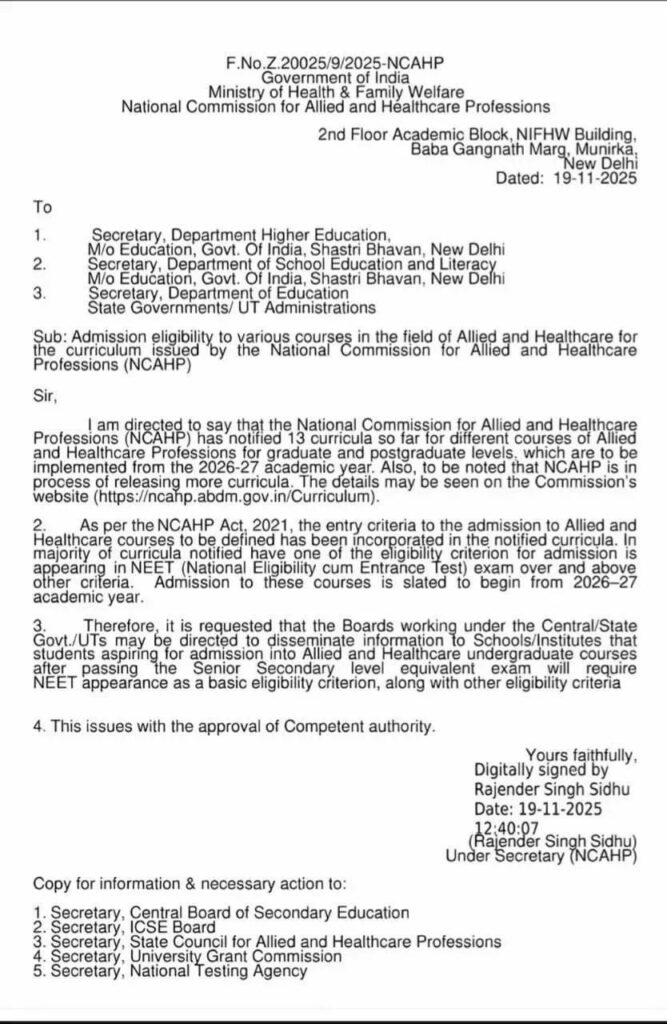
The notification further states that, in line with the NCAHP Act, 2021, the admission requirements for Allied and Healthcare programmes have been revised and integrated into the updated curricula. These changes will be implemented for admissions starting in the 2026–27 academic session.
NEET and Allied Health: A Growing Debate
NEET has traditionally served as an entrance exam for medical programmes, focusing heavily on subjects like physics, chemistry, and biology through objective questions. However, many allied health professions depend on interpersonal abilities, empathy, behavioural understanding, and communication—skills that are difficult to evaluate through such an exam format.
A notable concern has emerged among psychology aspirants and similar fields, who report confusion and stress as they attempt to study subjects irrelevant to their career goals. Educators point out that NEET does not assess competencies central to disciplines like psychology, nutrition, public health, or physiotherapy.
Uniform Entrance Test vs. Field-Specific Needs
Supporters of the policy argue that a common entrance test may reduce irregularities, establish transparency, and create a standardised selection process nationwide. Yet critics question whether this uniform approach undermines the specialised nature of allied health roles. They caution that a single evaluation system may limit diversity and overlook candidates whose strengths lie beyond theoretical science.
A Standardised System—But at What Cost?
This shift raises a broader dilemma: is standardisation worth the risk of misalignment with programme requirements? While the move aims to streamline admissions, many suggest that a universal test may not fully prepare students for professional realities in their chosen fields.
As the policy approaches its implementation in 2026–27, the sector faces an important question: can one national exam reflect the full spectrum of abilities needed across allied health professions, or will it prioritise academic uniformity at the expense of practical and human-centred skills?
Whether this change strengthens the system or creates new barriers remains to be seen, and ongoing dialogue among educators, policymakers, and students will be crucial as the transition unfolds.
Contact Us